Musings

Thursday, August 27, 2015

Sea Holly


Sea Holly must be the most striking plant of the dunes? This magnificent specimen of Eryngium maritimum was growing at the back of the beach at the Llangenith end of Rhossili beach. It caught my eye when the sun came out, silvery blue ruffs around the spiky inflorescence.

Wednesday, August 26, 2015

Wood Sage

This is another plant from the Pembrokeshire coast which I was a little suprised to find growing amidst the gorse and heather: Wood Sage, Teucrium scorodonia. It has a great Latin binomial.

Tuesday, August 25, 2015

Chough

"Pyrrhocorax pyrrhocorax -Penwith -Cornwall -flying-8b" by Andrew - originally posted to Flickr as chough. Licensed under CC BY 2.0 via Commons - https://commons.wikimedia.org/wiki/File:Pyrrhocorax_pyrrhocorax_-Penwith_-Cornwall_-flying-8b.jpg#/media/File:Pyrrhocorax_pyrrhocorax_-Penwith_-Cornwall_-flying-8b.jpg
My final catch-up post is of one of my favourite birds: the Chough, Pyrrhocorax pyrrhocorax, the red-legged red-billed member of the crow family and one of our rarest. It is confined to coasts in Wales and Cornwall. It is the county bird of Cornwall but absent for around fifty years until it re-colonised in 2001. The Latin name refers to the ancient belief that it was drawn to and caused fires, although the means by which it initiated conflagrations was never clearly elucidated. It has broader more rectangular wings in proportion to its body when compared with the other crows, with long separate primary 'fingers' which are seen clearly in the photo. It's call is described by the inestimably Geoff Sample as "whizzing zings" which is a perfectly succinct summary.
 

Betony


Catching up on missed posts: this is Betony, Stachys officinalis, growing amidst the bell heather and western gorse beside the coastal path. 
The specific name indicates longstanding usage by the herbalists. The Romans thought it protected against sorcery and later it was used to thwart witchcraft.

Rock Sea-spurrey


This was a new one for me and it's taken a little while to find it in the books. Close up it has exquisite little flowers and is densely covered in glandular hairs. It was growing right on the coastal path at the base of one of the stone 'steps' put in by the National Trust team. 
It is Rock Sea-spurrey, Spergularia rupicola, a member of the Caryophyllaceae family (Chickweeds, Pinks and Campions).

Babington's Orache


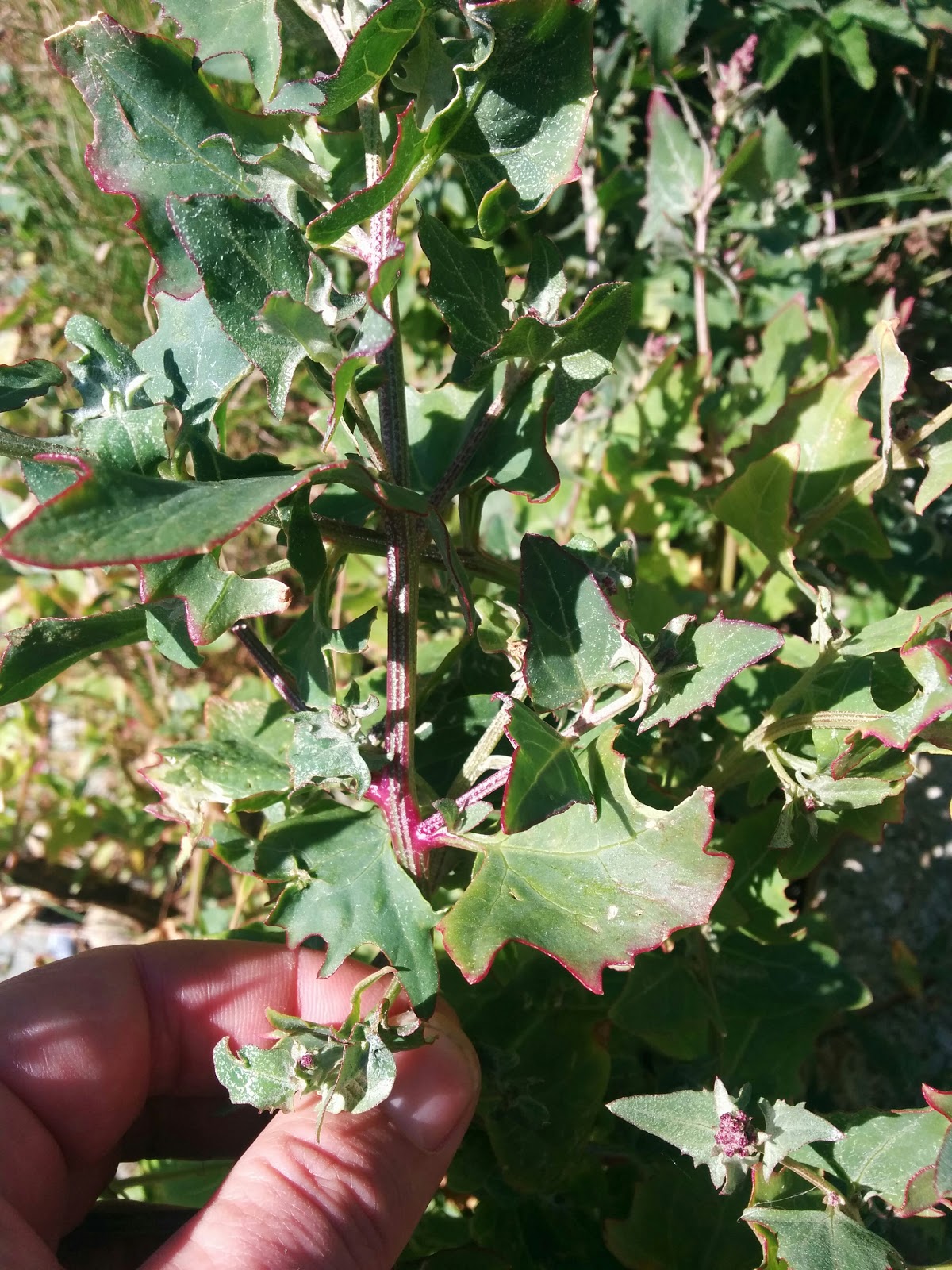
This is, I'm pretty sure, Babington's orache, Atriplex glabriuscula, sprawling over the shingle at the back of a beautiful little cove between Newgale and Solva on the Pembrokeshire coast. To be certain one would need to check the bracteoles, but as you can see from the photos the flowers are only just appearing. It can be difficult to distinguish from Spear-leaved orache, Atriplex prostrata.

Rock Samphire


Another coastal plant growing on a headland near Caerfai Farm. This was taken late on our last day. That night a cold front blew in and changed things utterly: high winds and torrential rain.
This is Rock Samphire, Crithmum maritimum, which is an unusual member of the Umbellifer family in that it has fleshy stems and leaves, like cacti. It is confined, as the binomial suggests, to coastal locations. Oddly it isn't found between the very north of Scotland and Suffolk. 

Monday, August 24, 2015

Hare's-foot clover


I have been unable to connect to the interweb for the last few days on account of having been stuck in some fields near Crickhowell with a large number (around 20,000) other (mostly white, middle-class) people. The result of such large numbers in a rural location was overload of the local mobile network to the extent that data-services were suspended. 
Now I am at my parents' house in Swansea I do have access, albeit at unfeasibly slow connection speeds. In fact it has only been possible to load a page without it timing out by fiddling with various techological bits. (For anyone of a sufficiently geeky bent, the ping time was initially over 2000ms with a download speed of 0.04MB/s.)
Enough excuses; there is a lot of catching up to do, most of which will be done tomorrow as it's now already late. But for today I offer you this lovely little Trifolium, Hare's-foot clover, Trifolium arvense. It was growing by the quayside at Solva which, having read the books, is just where you'd expect it to be growing. The Trifoliums are rather charming members of the Fabaceae family, aka the 'legumes', aka peas, vetches and clovers. They all have funny nodules in their roots which contain bacteria that can 'fix' nitrogen, i.e. convert inorganic nitrogen to organic.

Thursday, August 20, 2015

Bittersweet


Great looking flower and great common name: Bittersweet. It's also known as Woody Nightshade, revealing its close relationship with a deadly cousin. The Latin binomial reveals other relationships: Solanum dulcamara. It is in the same family as potatoes and tomatoes. Of the seven or so family members living in Great Britain this is the most widespread, often seen scrambling through brambles and hedgerows.
posted from Bloggeroid

Tufted Vetch


Missed yesterday's post; busy striking camp in a brisk westerly cold front complete with torrential rain. Lunch at the (still) querky Druidstone hotel before a circuitous route via Ammanford, Llandovery and Brecon back to Llanvihangel Crucorney's (no really) real fires for dinner.
Reviewing the haul from my coastal walks I thought I would post this, the vetch with the best name: Vicia cracca. I always hear it in my head as though spoken by Frank Carson.
posted from Bloggeroid

Tuesday, August 18, 2015

Redshank


This is Redshank, Persicaria maculosa, growing at the back of a beautiful sandy cove just west of Newgale beach. It was just above the small storm beach of pebbles where a stream disappeared beneath. 
This is the first member of the Dock family, Polygonaceae, which includes (besides the namesakes) Knotweeds, Bindweeds and Knotgrasses as well as Persicarias. It can be a tricky group due to small differences between species. This one is one of the easier ones as it often has a dark splodge on the leaves, just visible in this rather poor photo.
posted from Bloggeroid

Monday, August 17, 2015

Western Gorse


This is Western Gorse, Ulex gallii, growing by the Pembrokeshire Coastal Path alongside bell heather and some Ulex europaeus which is no longer in flower. Telling it apart from its big cousin can be tricky, but their flowering times differ and general growth habit, which helps when they are found in proximity. Also Western Gorse doesn't smell of coconut and has tiny bracteoles. The spines are only faintly furrowed and less robust than those of Gorse.
posted from Bloggeroid

Sunday, August 16, 2015

Sheep's-bit


This is Sheep's-bit, Jasione montana, seen today on a walk from the campsite along the coastal path to Solva. It is a member of the Bellflower family, Campanulaceae, and not a member of the Teasel family, Dipsacaceae, where the Scabiouses belong. The latter are often confused with the rampions and sheep's bits but they have opposite leaves and spiny calyces.
It was a lovely day; one that makes you question the need ever to travel overseas. And the Brains beer tasted especially good at the Harbour Inn.

posted from Bloggeroid

Saturday, August 15, 2015

Red Bartsia


This is Red Bartsia, Odonites vernus, which is a partial parasite on grasses. (see Yellow Rattle.) It is a member of the Figwort family.
Somewhat diminutive, it is easily overlooked, especially as the flowers are are small with muted colours.
posted from Bloggeroid

Thursday, August 13, 2015

Bog Asphodel


These beautiful bog asphodel, Narthecium ossifragum, were photographed when my friend Ian was visiting from France back in July. It was the same camera that took those extraordinary photos of the swallowtail caterpillar but without the fancy post-production. Still impressive I think. The orange anthers are striking, as are the hairy filaments and general delicate beauty of the inflorescence.
Although widespread in the north and west of Britain, they are relatively rare in the south, confined as they are to acid bogs, wet heaths and flushes.

Wednesday, August 12, 2015

Forest Bug

This is, I think, the first bug on the blog. Bugs differ from beetles in having a piercing beak, wings with membranous tips that overlap when not flying. They are the True bugs: the Hemiptera and there are 50,000 to 80,000 species. This is a shield bug. They belong to the sub-order Heteroptera (which accounts for around 40,000 species) and are sometimes referred to as the Typical bugs.
The Forest Bug, Pentatoma rufipes, belongs to the family Pentatomidae, so-called because of their five-segmented antennae (compared with the four found in most Heteropterans). It is common throughout Britain

Tuesday, August 11, 2015

Scalloped Oak

Much better haul with the trap last night, which is just as well as I woke up around 4am just as it started to drizzle and rushed out to through a waterproof over it. 
This was the most eye-catching of the bunch: a Scalloped Oak, Crocallis elinguaria. It's common throughout the British Isles.

Monday, August 10, 2015

Yarrow


This is a common flower at the moment. At first sight you think it's an umbelliferer, but in fact it's in the daisy family, Asteraceae. Yarrow, Achillea millefolium, is native throughout the temperate regions of the northern hemisphere where it has always been associated with the treatment of bleeding wounds. Hence its ancient name of herbal militaris. 
It also had other uses and was considered powerful by some for, and some against, evil. Mr Grigson tells us that in one part of the country girls would put the leaves up their noses and chant a rhyme that essentially asked that if their love should love them, let their nose bleed. I can't see that trending amongst the youth of today.

Sunday, August 09, 2015

Coronet moth

This is a beauty but not from last night's trap. Last night's trap caught precisely zero moths! Not sure what went wrong there. I have a feeling that there were too many gaps through which they might have escaped. I'll have another go tomorrow night.
It took me some time to narrow down possible identities and following furious interweb cross-checking I'm confident to announce that this is a Coronet, Craniophora ligustri. It's a fairly common moth, associated with calcareous scrub and woodland with ash trees and wild privet.

Saturday, August 08, 2015

Harlequin Ladybird

This was crawling about in the garden the other day. It is a harlequin ladybird, Harmonia axyridis. It started invading the UK in 2004 and is well on its way to the north of England. The UK has 46 resident species of ladybird (I know!) and it is feared some of these will succumb to competition from this voracious species. It was introduced into the USA in 1988 and is now the most common species there. 
If you've never indulged in any 'citizen science' before, sending in records of harlequin ladybird sightings is a great way to start.
Have set the moth trap tonight so fingers crossed for a hawkmoth or two!

Friday, August 07, 2015

Maidenhair Tree

As Katy and I wandered the more salubrious streets of Richmond waiting for our daughters to return from camp, this Ginko biloba caught my eye.
It is a freak survivor of a division of the plant kingdom known as the Ginkophyta which arose over 270 million years ago. Its closest relatives are the cycads, other 'living fossils' found mostly in the southern hemisphere. Both have motile sperm (as do the mosses, ferns and algae) which are structurally very similar. Ginkos are dioecious, meaning plants are either male or female.
The Maidenhair tree is the only species surviving in the entire division/class/order/family/genus. It was confined in the wild to central China but has been part of human culture for thousands of years.
It is used medicinally and as a food plant, but is also a popular specimen tree due to its peculiar growth habit and good autumn colours. In fact only yesterday Abbey and I were talking about getting one for the garden.  

Thursday, August 06, 2015

Ichneumon haemorrhoicus ssp crassigena


This creature arrested my attention down in the orchard. It was quite active but landed on various apple leaves to allow me to take some pictures.
I recognised it as an ichneumon wasp as one of its cousins appeared in the studio last year. Having scoured the interweb I am pretty certain this is Ichneumon haemorrhoicus ssp crassigena. Not the prettiest of names, but there we are, it makes up for it with its looks.
 

Wednesday, August 05, 2015

Common Blue


Okay, it's a bit of a rubbish photo, especially compared to those on Bob's Butterfly Blog, but I am doing this late (again) and it's to hand and I know what it is. It is a Common Blue, Polyommatus icarus, and what's more, it's a male: the females are brown (unless you live in Ireland or north-west Scotland where you might come across the blue marsicolore form). It was in my garden the other day whilst I was slaving away trimming some hot beech hedges. 
The explanation for why their wings are blue is fascinating and complex, but too elaborate for me to divulge at this time of the night. I refer you to the excellent Messrs Thomas and Lewington.

Tuesday, August 04, 2015

Dwarf Thistle

Frequent on the Downs, this is a prostrate member of the thistle family, the Dwarf Thistle or Cirsium acaule
And that's all I have to say about it.

Monday, August 03, 2015

Red-tailed Bumblebee

Not great pics (especially compared with Oliver's amazing photos of the Swallowtail caterpillar) but it is a beautiful creature with an arrestingly fiery tail.
This is the female red-tailed bumblebee, Bombus lapidarius. Unfortunately she's a dead one, found outside the back door. Easier to pose when dead, so you might have expected a better effort, but I was in a hurry. Note the 'mid-length proboscis'. 

Sunday, August 02, 2015

Jersey Tiger


We were making the most of the children being away and visiting old friends in London when one of them alerted me to the presence of an interesting moth at the front of the house on Camberwell Grove. It was flying around showing vibrant red underwings and my initial thought was that that was what it was. However, when I got home and looked it up it turns out to be the Nationally Scarce 'B' Jersey Tiger moth, Euplagia quadripunctaria
Until recently it was confined to the Channel Islands and south-west coast of England, but in the last ten years a colony has established in Forest Hill in south London, where presumably this one originated. Its range appears to be expanding.

Saturday, August 01, 2015

Old World Swallowtail

(c) Oliver Lloyd
(c) Oliver Lloyd
I couldn't resist blogging these amazing photos sent from Parthenay in France by a friend who is mastering the art of digital photography. These stunning images are produced using a technique known as focus stacking, something way beyond my understanding.
This is the caterpillar of the Swallowtail butterfly, Papilio machaon, and is likely to be the subspecies gorganus
There are in fact 37 recognised subspecies around the world! The one endemic to the UK is P. machaon ssp britannicus which is now confined to a few fens in East Anglia. You can see the imago here. This one is on fennel.
Machaon was the son of Asclepius, son of Apollo and god of medicine. He appears in the Iliad where he is wounded by Paris and put out of action, however he continues to cure others with herbs and surgery.