Musings

Showing posts with label garden. Show all posts

Wednesday, December 30, 2015

Azure Damselflies


A pair of Azure Damselflies, Coenagrion puella, flying in tandem and laying eggs in the pond back in June.

Tuesday, December 29, 2015

Iris Rust


This Iris foetidissima leaf is infected by the Iris Rust, Puccinia iridis. It is the sort of life one overlooks, even as someone with an expressed interest in natural history. The Rusts are all in the genus Puccinia. They are all obligate parasites of other plants and part of the Fungus kingdom, in the Basidiomycota phylum. There are over 4000 species worldwide, many of the them significant economic pests.

Tuesday, December 15, 2015

Pointed Spear-moss

CiarĂ¡n Byrne @kiwibyrne  

This grows (abundantly) in my lawn and I've tried a couple of times before to identify it. The last time was probably February, which was probably the last time I'd got the moss book out. It was a eureka moment to finally pin it down but not before I'd arsed about in the acrocarp keys: what an idiot! It's a pleurocarp of course. That's what happens when you don't know what you're doing and you don't start at the beginning.
Anyway, having dissected it under the stereomicroscope and looked at the cellular structure of the leaf under the compound microscope, I could have identified it without either if I'd just followed the key.
It is Pointed Spear-moss, Calliergonella cuspidata. I've nicked the photo from Ciaran Byrne's twitter feed. Ciaran is an amazing ecologist and prolific tweeter. I would urge anyone with Twitter access to follow him.

Thursday, December 10, 2015

Red Campion

"Red campion". Licensed under CC BY-SA 3.0 via Commons
Bizarrely I didn't take a picture of Red Campion, Silene dioica, so this is from the amazing resource that is Wikipedia. Red Campion is a bit more widespread than White Campion, growing up to 1000m altitude whereas White Campion is confined to lowland areas, especially those with calcareous soils. It grows at the back of the pond in the garden.

Sunday, December 06, 2015

Cinnamon Bug

This is a hemipteran bug from the Rhopalidae family: the Cinnamon or Black & Red Squash bug, Corizus hyoscyami. It is pretty common but can be confused with other red and black bugs like Firebugs, which are rare here but common on the continent.

Saturday, December 05, 2015

Straw Foxglove


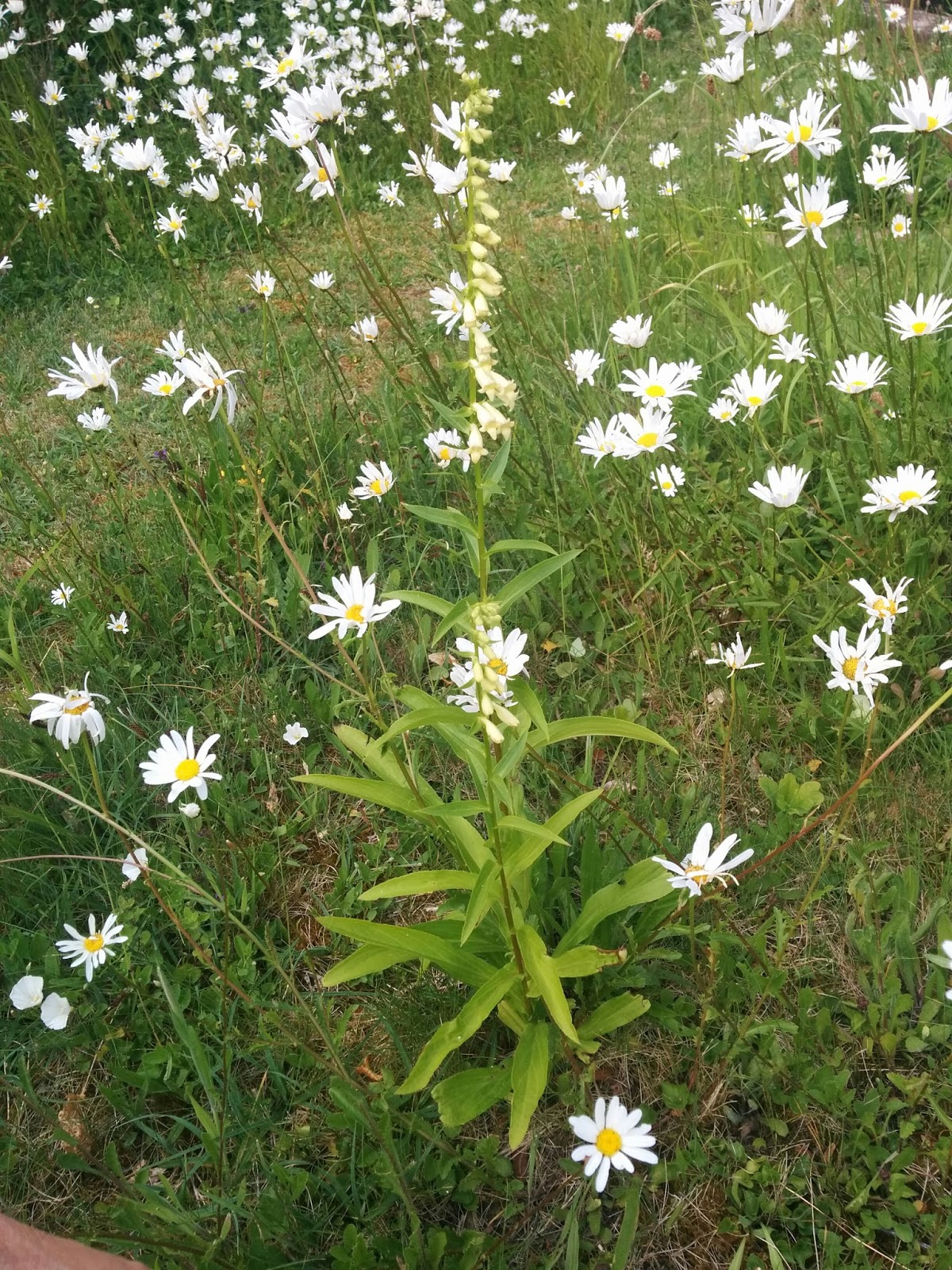
This appeared in our front lawn back in June. It looked like a foxglove but not like any foxglove I'd seen before. I did have a cursory look in the books to see if I could find it but failed to find it. Reviewing the year's photos I came across it again and this time I've found it. It's Straw Foxglove, Digitalis lutea, an introduced species that has naturalised in the south of the country. It's actually rather rare, as this BSBI map indicates, and there hasn't been a record in Sussex since 2010 when it was noted in Brighton.
The flowers are distinctly those of the Figwort family, Scrophulariaceae. The most striking feature is the extremely hairy corolla.

Tuesday, November 17, 2015

Great Willowherb


Growing in the garden, this is Great Willowherb, Epilobium hirsutum. It is, as the binomial suggests, very hairy. It has large flowers with a distinctive large creamy stigma with four lobes that arch backwards forming a cross.
Willowherbs are a family in their own right, but the family name is Onagraceae.
This is one of three posts needed to bring the blog up to speed, having been a bit slack at the end of October.
I have also noticed that I've blogged one species twice. A big money prize for anyone who spots which it is.

Friday, November 06, 2015

Coal Tit

"Coal tit" by Aviceda - Own work. Licensed under CC BY-SA 3.0 via Commons - https://commons.wikimedia.org/wiki/File:Coal_tit_UK09.JPG#/media/File:Coal_tit_UK09.JPG
I have enjoyed seeing the coal tits, Periparus ater, return to the feeders in the garden over the last few weeks. They are rarer than the other two common garden tits and generally prefer areas with conifers. They are about the size of blue tits but have a distinctive white cheek and white patch on the back of the head extending to the nape of the neck. They have a distinctive song which sounds like a slurred great tit call and it is this that usually alerts you to their presence, especially in mixed conifer/broadleaved woodland.

Monday, October 12, 2015

Mind-your-own-business


Could this be the plant every botanist longs to be asked to identify? I remember the first time I came across it with Abbey's cousin David, a better botanist than I, and asked him what it was. He's a retiring sort of chap so I was somewhat taken aback by his seemingly abrupt answer.
I've not seen Mind-your-own-business in flower, but it does produce tiny flowers from May to August. Soleirolia soleirolii is a member of the nettle family but isn't native. It was introduced from the northern Mediterranean. Another common name for it is Corsican Curse: it was first described from Corsica and can easily reproduce vegetatively, making it something of a weed in some situations.

Sunday, October 11, 2015

Sowbread


Out beneath a hedgerow near you, this was a familiar pot plant in my house when I was growing up: Sowbread or Cyclamen, Cyclamen hederifolium. The house variety would be bred for show but the wild plant is now widely naturalised in the UK. Like crocuses, they have a corm not a bulb.

Saturday, October 10, 2015

Southern Hawker


 Another Odonata for yesterday (missed due to long day at work). This magnificent specimen was hanging around the bottom of the garden back in July. It's a male Southern Hawker, Aeshna cyanea. 
It lays eggs on dead material in the pond which hatch the following spring. The following year they emerge from June onwards, flying as late as October. 

Thursday, October 08, 2015

Blue-tailed Damselfly


It's recently got a little harder to find new species I can easily identify. A bit of a worry as there's still another 80 or so days to go.
This was around our pond in July and August: the Blue-tailed damselfly Ischnura elegans. It is an early coloniser of new ponds (which ours is). It is smaller than the similar, but much rarer, Scarce Blue-tailed damselfly. (Clue in the name.)

Sunday, October 04, 2015

Nebria brevicollis

This is a ground beetle, Nebria brevicollis, found in the garden. It is almost identical to N. salina except that it has hairy legs and prefers drier habitats. 
The ground beetle family, Carabidae, are one of the largest known families, with over 40,000 species worldwide. In the UK there are around 350 species. That's nearly a year's worth for my blog!

Thursday, October 01, 2015

Male Fern


This grows in the garden: Male Fern, Dryopteris filix-mas. It is common in the UK, with kidney-shaped sori (bottom right). In ancient literature it is referred to as 'worm fern' because its root used to be used to treat worm infections. Filix means fern and mas means male. It was thought to be a male version of the Female Fern, Anthyrium filix-femina.

Monday, September 28, 2015

Old Man's Beard


This is Old Man's Beard or Traveller's Joy, aka Clematis vitalba
It is one of our few woody climbers and thrives on disturbed chalky soil, hence its prevalence round these parts. 
In the garden it is a particularly persistent pest. You can see the opposite leaves clearly in the upper left photo. 

Sunday, September 27, 2015

Dark Bush Cricket


This chap appeared on the back of one of the kitchen chairs on Saturday night, obviously keen to find its way to the sofa to watch one of the most memorable games of rugby ever played: England v Wales at Twickenham in the World Cup. Wales built from weakness, through adversity, to strength and final domination to beat England 28-25. It was an extraordinary match which took me back to my youth, supporting Wales at Cardiff Arms Park. 
You can tell he's a he due to the lack of ovipositor (the large, sickle-shaped thing that sticks out of the end of the female). He's a Dark Bush Cricket, Pholidoptera griseoaptera
You can hear its stridulations here:
British wildlife recordings

Lady's Bedstraw


This is Lady's Bedstraw, Galium verum. It has dark glossy 'leaves' which form whorls of six to twelve up the stems. In fact they are not all true leaves, which occur as opposite pairs; two are leaf-like stipules.
The leaves, on close inspection, are mucronate (end abruptly in sharp pointed tips).
It was, indeed, used to stuff mattresses, the coumarins in the plant acting as an insecticide against fleas. 
The yellow flowers were used to curdle milk and gave traditional Double Gloucester its colour.

Sunday, September 20, 2015

Red Admiral

This was taken back in mid-July but I saw one the other day so thought I'd mention it. An unmistakable butterfly known to most people, the Red Admiral, Vanessa atalanta, is not resident but comes up from Southern Europe to breed, the offspring returning in the Autumn. That's quite a journey for a small bird, let alone a butterfly.

Wednesday, September 16, 2015

Garden Spider

This is a male Garden Spider, Araneus diadematus, also known as a Cross, Diadem or Crowned Orb-weaver spider. It is one of our commonest spiders in the UK. The females are larger and have rounded abdomens: they occasionally eat the male after mating. These spiders can bite if provoked. It is like a mild bee sting.

Tuesday, September 08, 2015

Grey Dagger

I noticed this moth larva enjoying our Victoria Plum on Sunday. It's a Grey Dagger, Acronicta psi. Its close relative, the Dark Dagger, A. tridens, is impossible to distinguish as an imago (unless you get up very close and personal, and examine the genitals). The larvae are, however, easily told apart.
It is common, being found throughout the UK, with a predilection for most deciduous shrubs and trees.