
Monday, December 14, 2015
Watercress

Broad-leaved Pondweed


It's been so mild that there is quite a bit of growing going on out there. This is Broad-leaved Pondweed, Potamogeton natans, growing in one of the many ditches. It's only in this ditch that I've come across it, unlike the ubiquitous Lemma minuta. The pondweeds are a tricky group with around twelve species. This is fairly easy to identify because the leaves float and there is often a discoloured joint at the end of the long leaf-stalk.
Black-Tailed Godwit
 |
| By Richard Crossley (Richard Crossley) CC BY-SA 3.0 via Wikimedia Commons |
The similar Bar-Tailed Godwit has a barred tail (no, really) and an equally long beak which has a slight curve upwards. The Black-Tailed Godwit has been Red-Listed since 1996 but the numbers overwintering in Sussex have been increasing over the last 20 years with Pagham and Chichester harbours holding around 3% of the national total.
Thursday, December 10, 2015
Red Campion
 |
| "Red campion". Licensed under CC BY-SA 3.0 via Commons |
White Campion


Tuesday, December 08, 2015
Japanese Knotweed

Grove snail

 This is a common snail which can have be found with a wider variety of patterns. Cepaea nemoralis is known as a Grove snail or Brown-lipped snail and is a terrestrial, pulmonate, gastropod mollusc. Nice.
Sunday, December 06, 2015
Cinnamon Bug

Saturday, December 05, 2015
Straw Foxglove
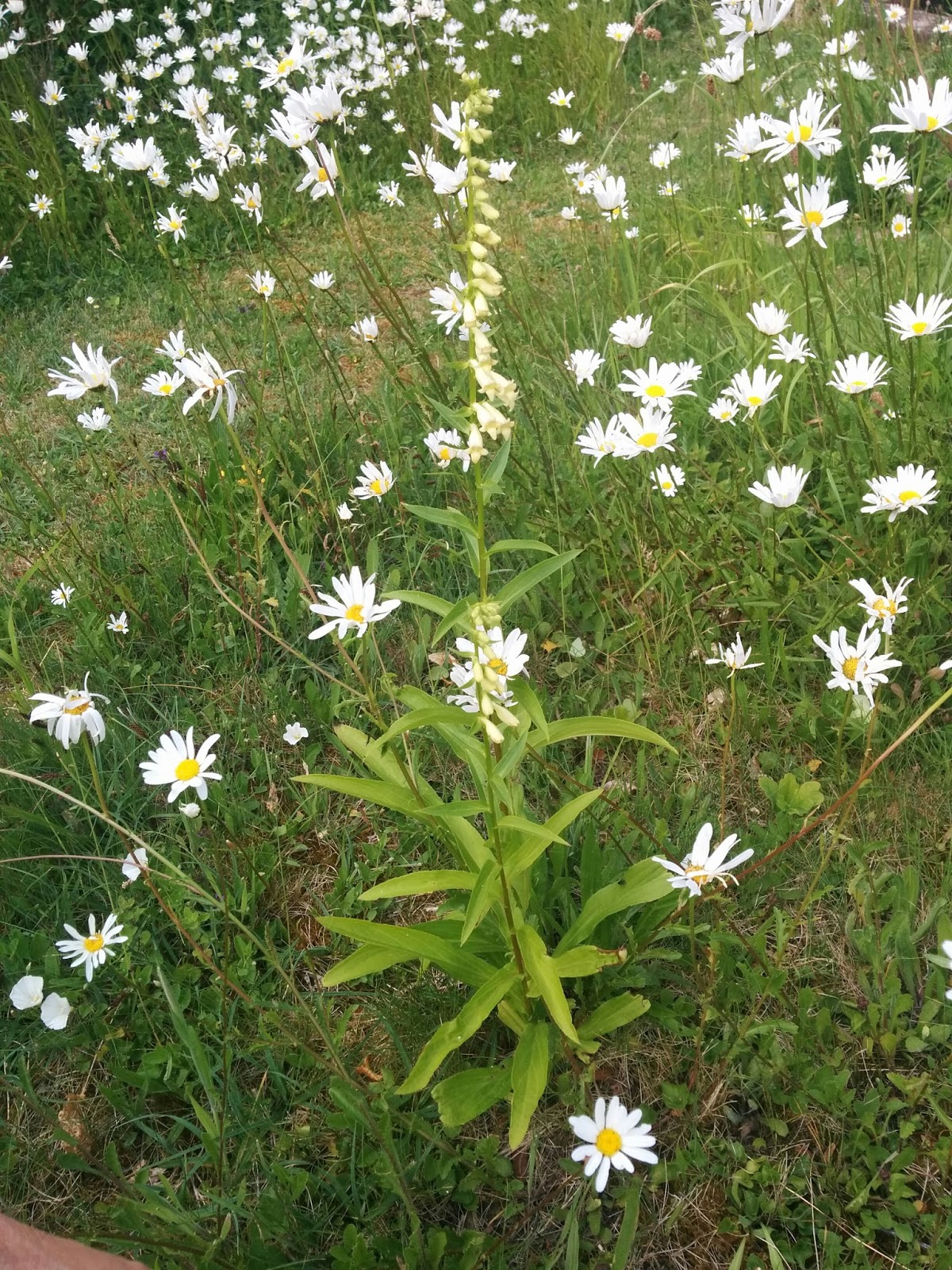


The flowers are distinctly those of the Figwort family, Scrophulariaceae. The most striking feature is the extremely hairy corolla.
Friday, December 04, 2015
Common Spotted-Orchid


Here's another common plant: the Common Spotted-Orchid, Dactylorhiza fuchsii. It has transversely elongated spots on its leaves (hence the name) which help distinguish it from Early Purple-Orchid, which has longitudinally elongated spots, and Heath Spotted-Orchid, which has circular spots. These plants were found on the same day, not far from each other, illustrating the range of colours and patterns found within this species.
Burnet Companion

Wednesday, December 02, 2015
Woodbine

Honeysuckle is famous for its scent, which is strongest at night to attract the long-tongued moths that pollinate it. They can detect it from quarter of a mile away (how is that known?).
Tuesday, December 01, 2015
Heath Spotted-Orchid


Although similar to the commoner Common Spotted-Orchid, this is Heath Spotted-Orchid, Dactylorhiza maculata, growing in fairly boggy ground in a ghyll in Ashdown Forest just next to the Lesser Skullcap posted recently. All orchids seem exciting. There's something exotic about them despite their abundance.
Monday, November 30, 2015
Giant Bellflower


Giant Bellflower is not common down south. This is the white form, Campanula latifolia var alba, which is often grown in gardens. Indeed this is likely to have escaped from a garden. It was found back in early July on the Downs near Lewes.
Lesser Skullcap


This is Lesser Skullcap, Scutellaria minor. It is not as common as Skullcap, which has toothed leaves and curved blue-violet flowers.
I came across this by a stream when I did my National Plant Monitoring Scheme surveys in July. It took me a while to identify!
Common Chameleon

Friday, November 27, 2015
Butcher's Broom

In many areas of the country it is an ancient woodland indicator. It used to be part of the Lily family but this has now been re-named the Asparagaceae family.
Thursday, November 26, 2015
Red Kite
 |
| "Red Kite - Gigrin Farm" by Tim Felce (Airwolfhound) - Red Kite - Gigrin Farm. Licensed under CC BY-SA 2.0 via Commons |
They remind me a little of Marsh Harriers with their striking wing markings and gliding habit of tail-twisting. In medieval times they kept the streets clean of carrion, helping to reduce the risk of water pollution and other sequelae of putrefaction.
Wednesday, November 25, 2015
Yellowhammer
 |
| "Emberiza citrinella -New Zealand" by Alan Vernon - originally posted to Flickr as Yellowhammer (Emberiza citrinella) in New Zealand, North Island. Licensed under CC BY 2.0 via Commons |
There were around twenty birds with half as many Chaffinch and a pair of Bullfinch. Certainly the largest flock I've seen to date. The intensity of the yellow male plumage is shocking when you first see it, making you think that this must be an escaped exotic such as a Canary.
They have a distinctive song which is usually rendered in the books as "a little bit of bread and chee-eese."
posted from Bloggeroid
Tuesday, November 24, 2015
Fieldfare
 |
| "Turdus pilaris" by Arnstein Rønning - Own work. Licensed under CC BY-SA 3.0 via Commons |
Subscribe to:
Posts (Atom)