Yes, another find from Ashdown. I think it's the first hoverfly (Diptera order, Syrphidae family) on the blog. I was looking at the excellent Hoverfly Recording site and according to them 106 hoverfly species have been recorded in my postcode (BN7)! This is Helophilus pendulus, one of the commonest species in the UK. Besides being important pollinators, hoverfly larvae are big aphid-eaters, making them a valuable friend in the garden.
Saturday, December 26, 2015
Dangling Marsh-lover
Yes, another find from Ashdown. I think it's the first hoverfly (Diptera order, Syrphidae family) on the blog. I was looking at the excellent Hoverfly Recording site and according to them 106 hoverfly species have been recorded in my postcode (BN7)! This is Helophilus pendulus, one of the commonest species in the UK. Besides being important pollinators, hoverfly larvae are big aphid-eaters, making them a valuable friend in the garden.
The Streakt Cloudy Hog
Having done the Streaked Golden Hog (aka Small Skipper) I realised I hadn't done this beauty, photographed during my extremely productive sojourn to Ashdown Forest back in July. It is the Large Skipper, Ochlodes sylvanus, the commonest of our eight Skipper family (Hesperiidae) butterflies. It used to be known as The Chequered Hog or Streakt Cloudy Hog - much better names if you ask me, especially the latter.
Thursday, December 24, 2015
Roesel's Bush-cricket
Found on the same day as the Mottled Grasshopper, this is a bush-cricket: Roesel's Bush-cricket, Metrioptera roeselii. You can tell a bush-cricket from a grasshopper easily: the latter have long antennae, usually longer than their bodies. Also the females have long, scythe-like ovipositors. Roesel's Bush-cricket has a cream edge to the prothorax. It is also an organism that is spreading in the UK as a result of global warming.
Wednesday, December 23, 2015
Goldenrod
Having re-discovered my photos taken on the camera (or possibly Ian's camera) there are lots of things from our trip to Ashdown Forest that I didn't use nearer the time. This is one - a rather striking member of the Daisy family, about 70cm tall, with delicate flowers in a tight raceme. It's Goldenrod, Solidago virgaurea and at the time I didn't recognise it. The upper leaves are quite distinctive and differ from the basal rosette of long obovate slightly toothed leaves.
It is found in a range of habitats: dry woodland (where it can be an Ancient Woodland Indicator), grasslands (as here), cliffs and dunes.
Sunday, December 20, 2015
Great Cormorant
![]() |
| Crossley ID Guide |
Creeping Feather-moss
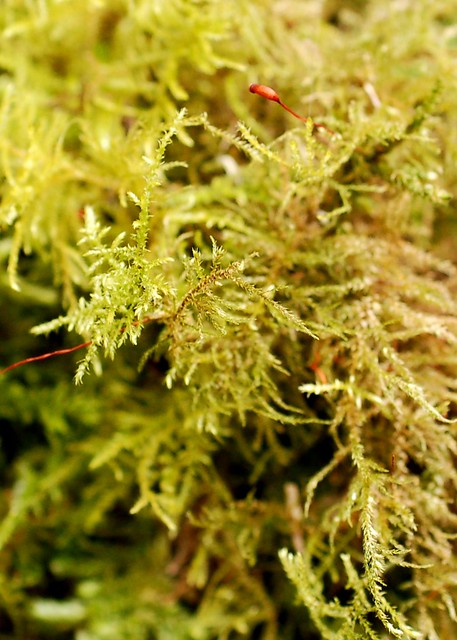
The problem with mosses is that it's very difficult to show them well in photographs. I was going to take a photo through the microscope but it didn't come out well and wouldn't be that instructive. This is a moss collected growing on the site of a WWI sea-plane hangar at Newhaven. (Well it's not the actual moss but the same species.) This time keying it out was a bit simpler - Creeping Feather-moss, Amblystegium serpens. It's very common and usually found on living or dead wood, but also on soil and stones, the bases of walls and tarmac.
Saturday, December 19, 2015
Rook
![]() |
| "Corvus frugilegus -Dartmoor" by Brian Snelson Licensed under CC BY 2.0 via Commons |
Black-Headed Gull
![]() |
| "Black-headed Gull from the Crossley ID Guide Britain and Ireland" by Richard Crossley - The Crossley ID Guide Britain and Ireland. Licensed under CC BY-SA 3.0 via Commons |
Purple Sandpiper
![]() |
| "Calidris maritima" by Andreas Trepte - Own work. Licensed under CC BY-SA 2.5 via Commons |
Tuesday, December 15, 2015
Pointed Spear-moss
![]() |
Ciarán Byrne @kiwibyrne |
Anyway, having dissected it under the stereomicroscope and looked at the cellular structure of the leaf under the compound microscope, I could have identified it without either if I'd just followed the key.
It is Pointed Spear-moss, Calliergonella cuspidata. I've nicked the photo from Ciaran Byrne's twitter feed. Ciaran is an amazing ecologist and prolific tweeter. I would urge anyone with Twitter access to follow him.
Monday, December 14, 2015
Watercress
This is Water-cress, Rorippa nasturtium-aquaticum, which is common in the ditches around the reserve. The Latin name gives away its culinary comparison with nasturtium - a peppery flavour. Care should be taken if eating wild Water-cress as it can harbour the cyst stage of liver-fluke, a parasite of sheep and cattle. Only take it from a stream with running water where there are no grazing animals.
Broad-leaved Pondweed
It's been so mild that there is quite a bit of growing going on out there. This is Broad-leaved Pondweed, Potamogeton natans, growing in one of the many ditches. It's only in this ditch that I've come across it, unlike the ubiquitous Lemma minuta. The pondweeds are a tricky group with around twelve species. This is fairly easy to identify because the leaves float and there is often a discoloured joint at the end of the long leaf-stalk.
Black-Tailed Godwit
![]() |
| By Richard Crossley (Richard Crossley) CC BY-SA 3.0 via Wikimedia Commons |
The similar Bar-Tailed Godwit has a barred tail (no, really) and an equally long beak which has a slight curve upwards. The Black-Tailed Godwit has been Red-Listed since 1996 but the numbers overwintering in Sussex have been increasing over the last 20 years with Pagham and Chichester harbours holding around 3% of the national total.
Thursday, December 10, 2015
Red Campion
![]() |
| "Red campion". Licensed under CC BY-SA 3.0 via Commons |
White Campion
Another plant I can't believe didn't get blogged before. The campions, Silene, are a familiar genus. Red Campion is probably best known, but White Campion, Silene latifolia, is also widespread. It can be confused with Bladder Campion and, by the sea, Sea Campion, which both have white flowers. White Campion is usually very hairy. It is also dioecious - having separate male and female plants.
Tuesday, December 08, 2015
Japanese Knotweed
This is the dreaded Japanese Knotweed, Fallopia japonica, introduced from Japan in 1825 and causing problems ever since. In my native Swansea it was a spectacular problem. Entering the city by train you passed through seemingly endless groves of it. It is listed by the World Conservation Union as one of the world's worst invasive species. In Australia it is actually illegal to have it growing on your property. This was growing on the edge of Amberley Brooks in West Sussex.
Subscribe to:
Posts (Atom)