Musings

Showing posts with label flower. Show all posts

Tuesday, March 01, 2016

Spurge-laurel


Came across this growing by the side of a path on our way to the Half Moon in Plumpton. It also caught the eye of our friend who was visiting who runs Alexandra Nursery in Penge (think Petersham on a smaller community scale). I've not seen it before but recognised it from Mr Rose's book. My subconscious botanist suggested laurel-spurge but on checking I find it's actually Spurge-Laurel, Daphne laureola. It looks like a garden escape or an introduced species but in fact it's native in England and Wales. The only other Spurge-laurel in the UK is Mezereon which seems to be even rarer.

Wednesday, December 23, 2015

Goldenrod


Having re-discovered my photos taken on the camera (or possibly Ian's camera) there are lots of things from our trip to Ashdown Forest that I didn't use nearer the time. This is one - a rather striking member of the Daisy family, about 70cm tall, with delicate flowers in a tight raceme. It's Goldenrod, Solidago virgaurea and at the time I didn't recognise it. The upper leaves are quite distinctive and differ from the basal rosette of long obovate slightly toothed leaves.
It is found in a range of habitats: dry woodland (where it can be an Ancient Woodland Indicator), grasslands (as here), cliffs and dunes.

Monday, December 14, 2015

Watercress

This is Water-cress, Rorippa nasturtium-aquaticum, which is common in the ditches around the reserve. The Latin name gives away its culinary comparison with nasturtium - a peppery flavour. Care should be taken if eating wild Water-cress as it can harbour the cyst stage of liver-fluke, a parasite of sheep and cattle. Only take it from a stream with running water where there are no grazing animals.

Broad-leaved Pondweed


It's been so mild that there is quite a bit of growing going on out there. This is Broad-leaved Pondweed, Potamogeton natans, growing in one of the many ditches. It's only in this ditch that I've come across it, unlike the ubiquitous Lemma minuta. The pondweeds are a tricky group with around twelve species. This is fairly easy to identify because the leaves float and there is often a discoloured joint at the end of the long leaf-stalk.


Thursday, December 10, 2015

Red Campion

"Red campion". Licensed under CC BY-SA 3.0 via Commons
Bizarrely I didn't take a picture of Red Campion, Silene dioica, so this is from the amazing resource that is Wikipedia. Red Campion is a bit more widespread than White Campion, growing up to 1000m altitude whereas White Campion is confined to lowland areas, especially those with calcareous soils. It grows at the back of the pond in the garden.

White Campion


Another plant I can't believe didn't get blogged before. The campions, Silene, are a familiar genus. Red Campion is probably best known, but White Campion, Silene latifolia, is also widespread. It can be confused with Bladder Campion and, by the sea, Sea Campion, which both have white flowers. White Campion is usually very hairy. It is also dioecious - having separate male and female plants.

Tuesday, December 08, 2015

Japanese Knotweed

This is the dreaded Japanese Knotweed, Fallopia japonica, introduced from Japan in 1825 and causing problems ever since. In my native Swansea it was a spectacular problem. Entering the city by train you passed through seemingly endless groves of it. It is listed by the World Conservation Union as one of the world's worst invasive species. In Australia it is actually illegal to have it growing on your property. This was growing on the edge of Amberley Brooks in West Sussex.

Saturday, December 05, 2015

Straw Foxglove


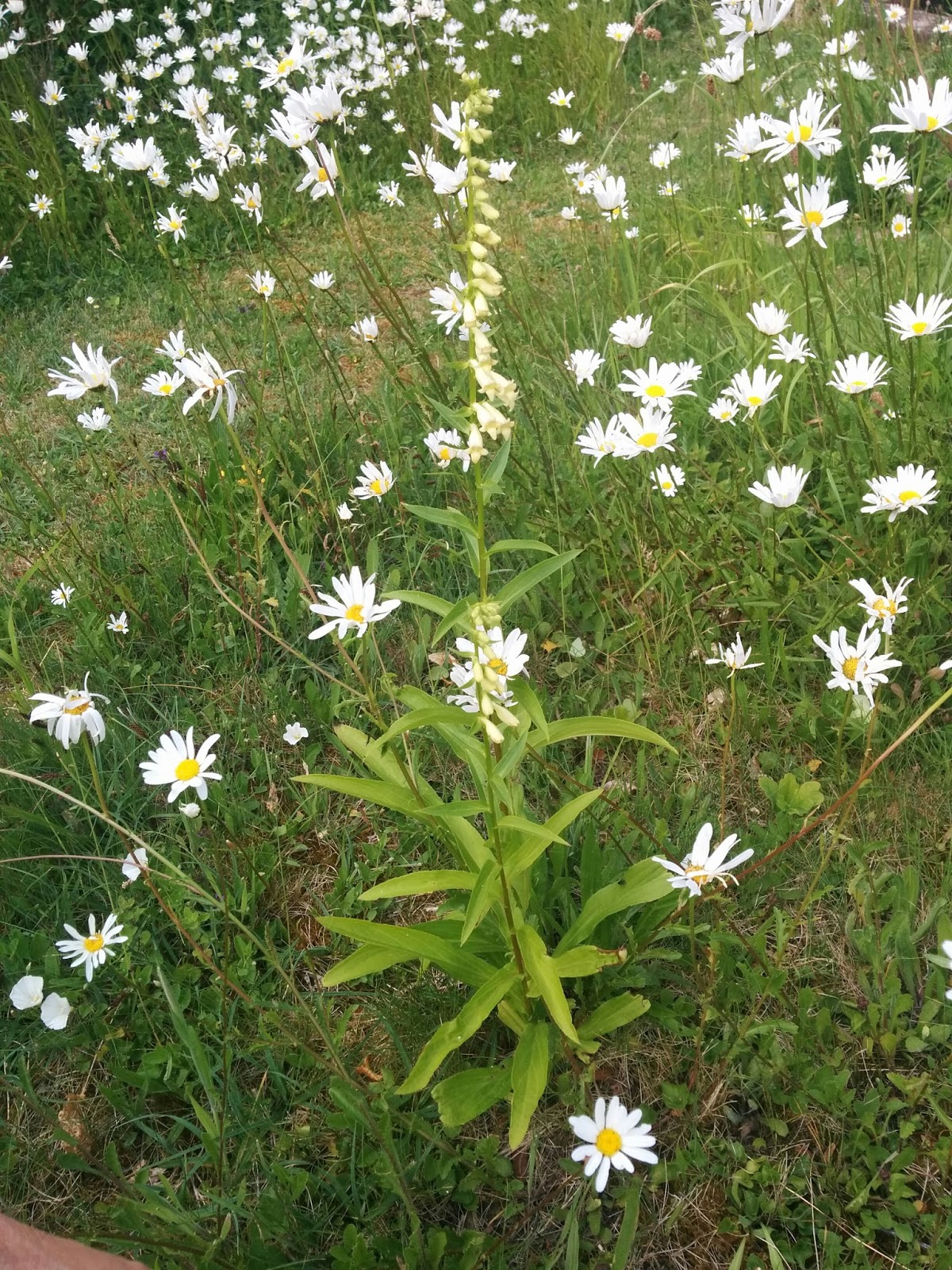
This appeared in our front lawn back in June. It looked like a foxglove but not like any foxglove I'd seen before. I did have a cursory look in the books to see if I could find it but failed to find it. Reviewing the year's photos I came across it again and this time I've found it. It's Straw Foxglove, Digitalis lutea, an introduced species that has naturalised in the south of the country. It's actually rather rare, as this BSBI map indicates, and there hasn't been a record in Sussex since 2010 when it was noted in Brighton.
The flowers are distinctly those of the Figwort family, Scrophulariaceae. The most striking feature is the extremely hairy corolla.

Friday, December 04, 2015

Common Spotted-Orchid


Here's another common plant: the Common Spotted-Orchid, Dactylorhiza fuchsii. It has transversely elongated spots on its leaves (hence the name) which help distinguish it from Early Purple-Orchid, which has longitudinally elongated spots, and Heath Spotted-Orchid, which has circular spots. These plants were found on the same day, not far from each other,  illustrating the range of colours and patterns found within this species.


Wednesday, December 02, 2015

Woodbine

I didn't realise that Woodbine was a synonym for Common Honeysucke, Lonicera periclymenum. I was also suprised I hadn't already blogged this as it's a lovely and common plant. There turn out to be lots of photos of plants taken in the middle of the year when there was an abundance in flower which I didn't have 'room' for at the time. 
Honeysuckle is famous for its scent, which is strongest at night to attract the long-tongued moths that pollinate it. They can detect it from quarter of a mile away (how is that known?).

Tuesday, December 01, 2015

Heath Spotted-Orchid


Although similar to the commoner Common Spotted-Orchid, this is Heath Spotted-Orchid, Dactylorhiza maculata, growing in fairly boggy ground in a ghyll in Ashdown Forest just next to the Lesser Skullcap posted recently. All orchids seem exciting. There's something exotic about them despite their abundance.

Monday, November 30, 2015

Giant Bellflower


Giant Bellflower is not common down south. This is the white form, Campanula latifolia var alba, which is often grown in gardens. Indeed this is likely to have escaped from a garden. It was found back in early July on the Downs near Lewes.

Lesser Skullcap


This is Lesser Skullcap, Scutellaria minor. It is not as common as Skullcap, which has toothed leaves and curved blue-violet flowers. 
I came across this by a stream when I did my National Plant Monitoring Scheme surveys in July. It took me a while to identify!

Friday, November 27, 2015

Butcher's Broom

I came across this growing at the base of a hedge bordering a driveway to some old cottages and the church at Compton Beauchamp. It's Butcher's Broom or Ruscus aculeatus. It is a peculiar plant. The 'leaves' are actually flattened modified stems (cladodes) in the middle of which the small whitish flowers appear. The red fruit look almost artificial in colour.
In many areas of the country it is an ancient woodland indicator. It used to be part of the Lily family but this has now been re-named the Asparagaceae family.

Monday, November 23, 2015

Common Duckweed


This grows in the ditches down on the reserve at Lewes Brooks. It's Common Duckweed, Lemna minor. There are other Lemnas...Greater, Rootless, Least, Fat and Ivy-leaved. So you don't have to settle on this one. But you do need to get up close to discern them. Minor has three veins but minuta (Least) only has one.

Sunday, November 22, 2015

Flowering Currant


I took this back in April. It's a garden escape because it isn't native here, originating from the western United States and Canada. It is Flowering Currant, Ribes sanguineum, and its attractive flowers and early flowering make it something of a  horticultural favourite. It was introduced to this country in 1826 with the first record of a naturalised plant in 1916. Since that time it has spread and can be found from the Highlands to the south coast.

Tuesday, November 17, 2015

Buddleia


This is the third and final catch up species today: Buddleia or Butterfly Bush, Buddleja davidii. The irony is that although butterflies love it, it is often responsible for shading out the food plants of the caterpillars. It was introduced from China and is now an established invasive species. The French missionary and botanist, Jean Andre Soulie, who sent it back at the beginning of the twentieth century, was tortured and shot by Tibetan monks in 1905.

Pineappleweed


The second catch-up species - Pineappleweed, Matricaria discoidea, growing, characteristically, on a bare patch of path. 
When crushed it smells of pineapple, unlike the Buttonweed, Cotula coronopifolia, which is resembles. The latter is an introduced species found on damp muddy waysides and dunes.

Great Willowherb


Growing in the garden, this is Great Willowherb, Epilobium hirsutum. It is, as the binomial suggests, very hairy. It has large flowers with a distinctive large creamy stigma with four lobes that arch backwards forming a cross.
Willowherbs are a family in their own right, but the family name is Onagraceae.
This is one of three posts needed to bring the blog up to speed, having been a bit slack at the end of October.
I have also noticed that I've blogged one species twice. A big money prize for anyone who spots which it is.

Burnet Rose


This is Burnet Rose, Rosa pimpinellifolia, growing in dunes at Llangennith at the end of Gower. There were no cream flowers at the end of August when this photo was taken, but the distinctive black globose fruit and red stems with red-tinged leaves are distinctive. 
The Roses are one of the trickiest groups to identify accurately. There is a whole BSBI Handbook devoted to the matter by the inestimable Rev Dr Anthony Primavesi. They also hybridise, further complicating the issue.