Musings

Sunday, November 08, 2015

Buzzard

Buteo buteo by Arend from Oosterhout, Netherlands Licensed under CC BY 2.0
https://pdrmg.wordpress.com/gallery/buzzard-in-flight/ by Mike Price


Yet another missed day on the blog! Sign of blog fatigue perhaps. Or it could have been the distraction of preparing for my elder daughter's 18th birthday party which was chez nous. Certainly the lateness of the finish and the current time are conspiring to make these two posts short and sweet.
So this is the Common Buzzard, Buteo buteo, the UK's commonest bird of prey, overtaking the Kestrel in the last 10 years. When I first moved to Lewes there were no buzzards nearby but now several pairs have territories in the surrounding area.
They have distinctively swept forward wings when soaring but it is often the even more distinctive mewing cry that draws one's attention.

Friday, November 06, 2015

Coal Tit

"Coal tit" by Aviceda - Own work. Licensed under CC BY-SA 3.0 via Commons - https://commons.wikimedia.org/wiki/File:Coal_tit_UK09.JPG#/media/File:Coal_tit_UK09.JPG
I have enjoyed seeing the coal tits, Periparus ater, return to the feeders in the garden over the last few weeks. They are rarer than the other two common garden tits and generally prefer areas with conifers. They are about the size of blue tits but have a distinctive white cheek and white patch on the back of the head extending to the nape of the neck. They have a distinctive song which sounds like a slurred great tit call and it is this that usually alerts you to their presence, especially in mixed conifer/broadleaved woodland.

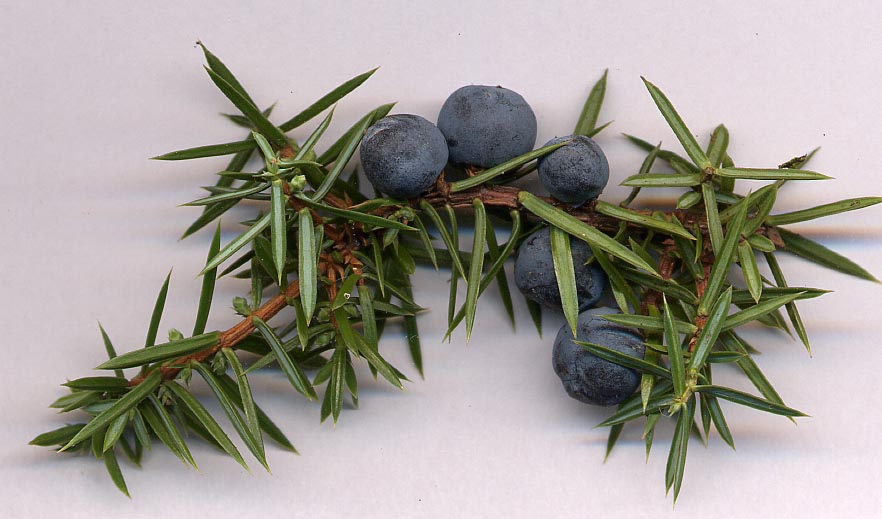
Juniper

Luis Fernández García Own work. Licensed under CC BY 2.5 via Commons
"Juniperus communis cones" by MPF - Own work. Licensed under CC BY 2.5 via Commons
I noticed this on the way back from Brighton coming down the A27 from the Ditchling junction and it reminded me that I've been meaning to post it on the blog. Back near the start of this daily species malarkey I did the two other native conifers found the UK, Scot's Pine and Yew. This is the third and least prevalent: Common Juniper, Juniperus communis. However, in global terms it is the apparently the most widespread woody plant!
Its common name in French genievre gives us our name for gin, the spirit which is flavoured with juniper 'berries' (amongst other aromatics). 
What's odd about juniper is that it grows in two quite different habitats in the UK. In the north it grows in wet, acidic conditions on hills and moors; in the south it is found on dry, calcareous soils such as the chalk that forms the Downs.

Wednesday, November 04, 2015

Ring-necked Parakeets

http://animalia-life.com/birds/rose-ringed-parakeet.html
Another bird from Gran Canaria: the Ring-necked parakeet, Psittacula krameri. Look familiar? If you live in the south east of England it may do. As with Gran Canaria, they are an introduced species. The ones in Britain were released or escaped in the 1970s and became established in Richmond Park. Since then they have colonised most of London and are spreading out beyond the M25. They are noisy creatures and were forever racing about in small groups amongst the palm trees.

Tuesday, November 03, 2015

Atlantic gull or Yellow-legged gull

http://www.rspb.org.uk/discoverandenjoynature/discoverandlearn/birdguide/name/y/yellowleggedgull/
There were plenty of these out in the Canaries: Yellow-legged gulls, Larus michahellis ssp atlantis. They are interesting because only recently were they recognised as a species in their own right. Prior to the 1990s people lumped them with the Herring gull or sometimes with the Caspian gull. British Birds magazine was the first to consider it a full species back in 1993 but the British Ornithologists Union waited until 2007 to do so. DNA evidence shows that it is more closely related to the Great Black-backed gull than the Herring gull. 
The Macaronesian subspecies is often referred to as the Atlantic gull and it may, in due course, be recognised as a full species. It seems that DNA analysis favours the splitters more than the lumpers.

Monday, November 02, 2015

Hoopoe

"Hoopoe (Upupa epops)" by Arturo Nikolai Licensed under CC BY-SA 2.0 via Commons
Another thematic species from our Gran Canaria trip. I'd only seen one once before in Europe when staying with friends in Parthenay, France. It's a Hoopoe, Upupa epops, and a year round resident in the Canaries. In France it's a migrant breeder. In fact it is found throughout France in the summer but rarely makes it across the channel.
They are actually quite small, about the size of a starling, and the bill is extremely fine and delicate-looking. The name, both common and binomial, is onomatopoeic after its call.

Sunday, November 01, 2015

Canary Island Palm

I was going to 'catch up' on blog posts today but there's been too much to do having arrived back in the small hours of the morning, so here's an iconic plant from the archipelago: the Canary Island Palm, Phoenix canariensis. This was a particularly impressive specimen in the dunes of Maspalomas on Gran Canaria. 
There are fourteen species in the genus and this one is widely planted as an ornamental.

Wednesday, October 28, 2015

Yellow Dung Fly


I thought we might be overdue diptera so here are a pair of mating Yellow Dung Flies, Scathophaga stercoraria, at it hammer and tongs up on the Downs. The male is on top with the fancy golden hairy pantaloons. They are one of the commonest flies in the world, their distribution reflecting that of human animal husbandry. 
They are also one of the most studied organisms in the world, lending themselves, like their prey and smaller cousins the fruit fly Drosophila melanogaster, to scientific experiment as a result of their rapid reproductive turnover.
The female lays her eggs on fresh dung and the larvae grow through three stages over five days. They then spend a further five days emptying their stomachs before burying down beneath the dung to pupate.
The young flies are anautogenous, which means they can't crack on with the sex until they've fed up for it. 
No shit!

Shepherd's Purse


Another annual ruderal species which is common round us in Sussex. It is appropriate to find it on the Downs, whose landscape and habitats are a direct result of sheep grazing over millennia, for it is known as Shepherd's purse, Capsella bursa-pastoris. It is a member of the mustard family, Brassiaceae and not a native but an archeophyte. 
An archeophyte is a naturalised plant introduced before 1492 (yes, Columbus and all that) whereas after that date such plants are known as neophytes. 
The reason for its common name (a direct translation of the Latin specific) is the shape of the seed pods apparently resembling the purse carried by shepherds. Which shepherds and when is hard to discover.

Common Eyebright agg.


Beautiful, beguiling, but very very tricky. Even the Plant Crib (BSBI) is coy when it comes to identifying this group, referring you to other monographs on the genus and to Stace. I believe there is a BSBI Handbook under construction but in most accounts the Eyebright, Euphrasia officinalis agg. , is usually not identified to the species, sub-species, or hybrid level. Essentially it requires an expert to come and see your plant in the field to make a confident stab at it. 
They belong to the Orobanchaceae family (I think I've posted Common Broomrape if you are interested to search) which have in common that they are all parasitic or semi-parasitic on other plants. In the case of the Eyebrights the grasses provide the without-which-not. 
The common name derives from their use in the treatment of eye conditions such as conjunctivitis and blepharitis, both as a decoction and a poultice. 

Red Clover


This is Red Clover, Trifolium pratense, a member of the bean family, Fabiaceae. As such, it has the special root nodules containing bacteria which fix nitrogen, making it widely planted as a soil improver. I had thought it was another annual, but it is in fact a 'short lived perennial'. I'm not exactly sure what the definition of 'short lived' might be, but suspect at least three years (or it would be 'biennial') and fewer than thirty.

Common Knotweed


Another common annual - this is Common Knotweed, Polygonum aviculare. It is in the family Polygonaceae which contains all the docks and buckwheat. The Latin derives from 'many knees' as the nodes of many species are swollen, looking like knees. The papery stipules form a sheath known as an ochrea

Scarlet Pimpernel


Another common ruderal species found on light soils, this annual is Scarlet Pimpernel, Anagallis arvensis. Emma Orczy's eponymous fictional character is named after the plant, which featured on his calling card left to goad his enemies. It flowers for most of the year and belongs to the same family as the Primrose. 
I must apologise for the hiatus in publication. This is due to a holiday on Gran Canaria which has inflicted deep lassitude through excessive hedonism. I am trying to overcome my predicament.

Thursday, October 22, 2015

Spanish or Lusitanian Slug

Hmmm, time for another mollusc. Not as cute as the Door Snail but certainly commoner, in the south at least. This is an invasive species, originally referred to as the Lusitanian slug but now usually known as the Spanish Slug: Arion vulgaris. It lays more eggs than our native slugs and they are more resistant to drought. It also has a less discerning diet.
This one is chasing a leucistic cousin. 


Wednesday, October 21, 2015

Bristly Oxtongue


 Something of an oversight not to have posted this common 'weed'. It has distinctive blisters on its leaves and distinctive out involucre bracts that look like hairy sepals (see top left picture). The seeds are 'beaked' which means that there is a stalk between the top of the seed and the pappus parachute. It's not terribly obvious but you can just about make it out in the bottom right seed.
And it is called Bristly Oxtongue, Picris echioides
(Rose (see useful books) warns us that another plant has leaves with blisters: Green Alkanet. I'll look out for it and post if I find any.)


Hemp-agrimony


I didn't manage to post anything yesterday as it was Matty's 18th birthday and after work we were straight to the restaurant to celebrate, getting back late. However, on my way back to the car I came across some Hemp-agrimony flowering well on a north-east slope behind the hospital. Eupatorium cannabium is derived from Eupatoria (agrimony) and the Latin for hemp.

Monday, October 19, 2015

Sunday, October 18, 2015

Agrimony


So this is today's post (as opposed to the previous post, which was in fact 'yesterday's' post). It's another plant I'm surprised I haven't done before as it is, like Selfheal, common, especially round these chalky parts.
It is Agrimony, Agrimonia eupatoria, a member of the Rose family. 
You can tell it's not Fragrant Agrimony because it's not 'up north' and also the receptacle cup's hooked bristles are all pointing forwards or at most horizontal, as opposed to reflexed. 

Selfheal


And there was I thinking I'd posted something yesterday. Wrong! I think I got distracted after I put my back out in the process of unblocking one of our most important drains: the one that takes the waste water from the washing machine. (We had developed a grey-water spring that appeared in the flowerbed outside the back door every time we used the washing machine over the last week.) A judicious cocktail of drugs and the diversion of Keef's 50th birthday bash conspired to make me forget the blog.
Anyhow, a short but scenic autumnal stroll with Abbey and Molly along the Downs to Itford Hill from Beddingham Hill threw up a number of interesting species.This, Selfheal or Prunella vulgaris, I thought I'd already posted, but apparently not. So here it is. 
It's a member of the Dead-nettle family, Lamiaceae. 

Friday, October 16, 2015

Marsh Thistle


Not dissimilar to Creeping Thistle, this is Marsh Thistle, Cirsium palustre. Distinguished by the spiny-winged stems with sessile hairy leaves. Another member of the Asteraceae.