Musings

Showing posts with label insect. Show all posts

Sunday, September 27, 2015

Dark Bush Cricket


This chap appeared on the back of one of the kitchen chairs on Saturday night, obviously keen to find its way to the sofa to watch one of the most memorable games of rugby ever played: England v Wales at Twickenham in the World Cup. Wales built from weakness, through adversity, to strength and final domination to beat England 28-25. It was an extraordinary match which took me back to my youth, supporting Wales at Cardiff Arms Park. 
You can tell he's a he due to the lack of ovipositor (the large, sickle-shaped thing that sticks out of the end of the female). He's a Dark Bush Cricket, Pholidoptera griseoaptera. 
You can hear its stridulations here:
British wildlife recordings

Wednesday, September 16, 2015

Garden Spider

This is a male Garden Spider, Araneus diadematus, also known as a Cross, Diadem or Crowned Orb-weaver spider. It is one of our commonest spiders in the UK. The females are larger and have rounded abdomens: they occasionally eat the male after mating. These spiders can bite if provoked. It is like a mild bee sting.

Tuesday, September 08, 2015

Grey Dagger

I noticed this moth larva enjoying our Victoria Plum on Sunday. It's a Grey Dagger, Acronicta psi. Its close relative, the Dark Dagger, A. tridens, is impossible to distinguish as an imago (unless you get up very close and personal, and examine the genitals). The larvae are, however, easily told apart.
It is common, being found throughout the UK, with a predilection for most deciduous shrubs and trees.

Sunday, September 06, 2015

House Spider

I'm not really keen on spiders; slightly phobic like so many people. It's annoying. I've been trying to overcome it by taking a more scientific interest. 
This is the common house-spider, Tegenaria domestica, which can grow to a considerable (and scary!) size. They are fast movers too. This one was posing nicely so I thought I'd snap it for the blog. It is a male I think: more elongated body and impressive pedipalps. The latter also contain a small chamber for storing semen prior to fertilising the female. 
I confess I didn't have the nerve to pick it up so encouraged it to get off my clothes by annoying it slightly.

Saturday, August 08, 2015

Harlequin Ladybird

This was crawling about in the garden the other day. It is a harlequin ladybird, Harmonia axyridis. It started invading the UK in 2004 and is well on its way to the north of England. The UK has 46 resident species of ladybird (I know!) and it is feared some of these will succumb to competition from this voracious species. It was introduced into the USA in 1988 and is now the most common species there. 
If you've never indulged in any 'citizen science' before, sending in records of harlequin ladybird sightings is a great way to start.
Have set the moth trap tonight so fingers crossed for a hawkmoth or two!

Thursday, August 06, 2015

Ichneumon haemorrhoicus ssp crassigena


This creature arrested my attention down in the orchard. It was quite active but landed on various apple leaves to allow me to take some pictures.
I recognised it as an ichneumon wasp as one of its cousins appeared in the studio last year. Having scoured the interweb I am pretty certain this is Ichneumon haemorrhoicus ssp crassigena. Not the prettiest of names, but there we are, it makes up for it with its looks.
 

Monday, August 03, 2015

Red-tailed Bumblebee

Not great pics (especially compared with Oliver's amazing photos of the Swallowtail caterpillar) but it is a beautiful creature with an arrestingly fiery tail.
This is the female red-tailed bumblebee, Bombus lapidarius. Unfortunately she's a dead one, found outside the back door. Easier to pose when dead, so you might have expected a better effort, but I was in a hurry. Note the 'mid-length proboscis'. 

Wednesday, July 15, 2015

Southern Hawker

A very enjoyable 24 hours with my friend Ian who now lives in France who also has an interest in #lifewildaroundus. Coupled with a recently acquired snazzy new Sony alpha6000 mirrorless digital camera and an array of lenses (including a proper macro) it has been something of a bioblitz!
Down in the 'orchard' looking for butterflies we couldn't help noticing this prehistoric monster whizzing around trying to choose as suitable perch. 
Although Ian has some cracking close-ups I must just mention that the full-length portrait is all my own (and my Nexus 5's) work!
This is one of the minority of species which is actually doing well in this country. It is expanding its range slowly northwards.
This Southern Hawker, Aeshna cyanea, is a chap who in all likelihood emerged in the last week or so. Our little pond might be enough for him to consider a kingdom for the next few weeks.
Close-up of Southern Hawker - Ian Lloyd (2015)
 

Thursday, June 04, 2015

Broad-bodied Chaser


This is a female broad-bodied chaser, Libellula depressa. In fact it's two broad bodied chasers, the lower right one having been photographed a few weeks ago. They are one of the first dragonflies to emerge and also one of the commonest (unless you're in Scotland). They tend to hang vertically down from tall vegetation and make short flights every 20 - 90 seconds, so I was surprised to find the one in the top left photo sitting in the short grass. It looked to me as though it may have been injured: you can see in the top right that the left forewing is askew. The males have powder blue abdomens with yellow spots along the margins.
Dragonflies and damselflies are members of the order Odonata. They spend most of their lives as nymphs in water. Our pond is teaming with them and they are best seen at night with a powerful torch.


Wednesday, June 03, 2015

Red-headed Cardinal Beetle


Red-headed cardinal beetle, Pyrochroa serraticornis, turned up in my garden within a week of seeing its cousin out in Ashdown Forest. I confess to never having knowingly noticed either of these beetles before. It just goes to show how much more attention one pays to life wild around us when one is writing a daily blog about such things!
It turns out that there are only three species in the cardinal beetle family, two in the Pyrochroa genus with the third being the Scarce cardinal beetle, Schizotus pectinicornis. It may suprise you to learn that the latter isn't as widespread as the other two. If I come across one, I shall be sure to post it here at the first opportunity.
All of them are saproxylic, meaning they feed on dead wood.

Monday, May 25, 2015

Cryptocephalus aureolus


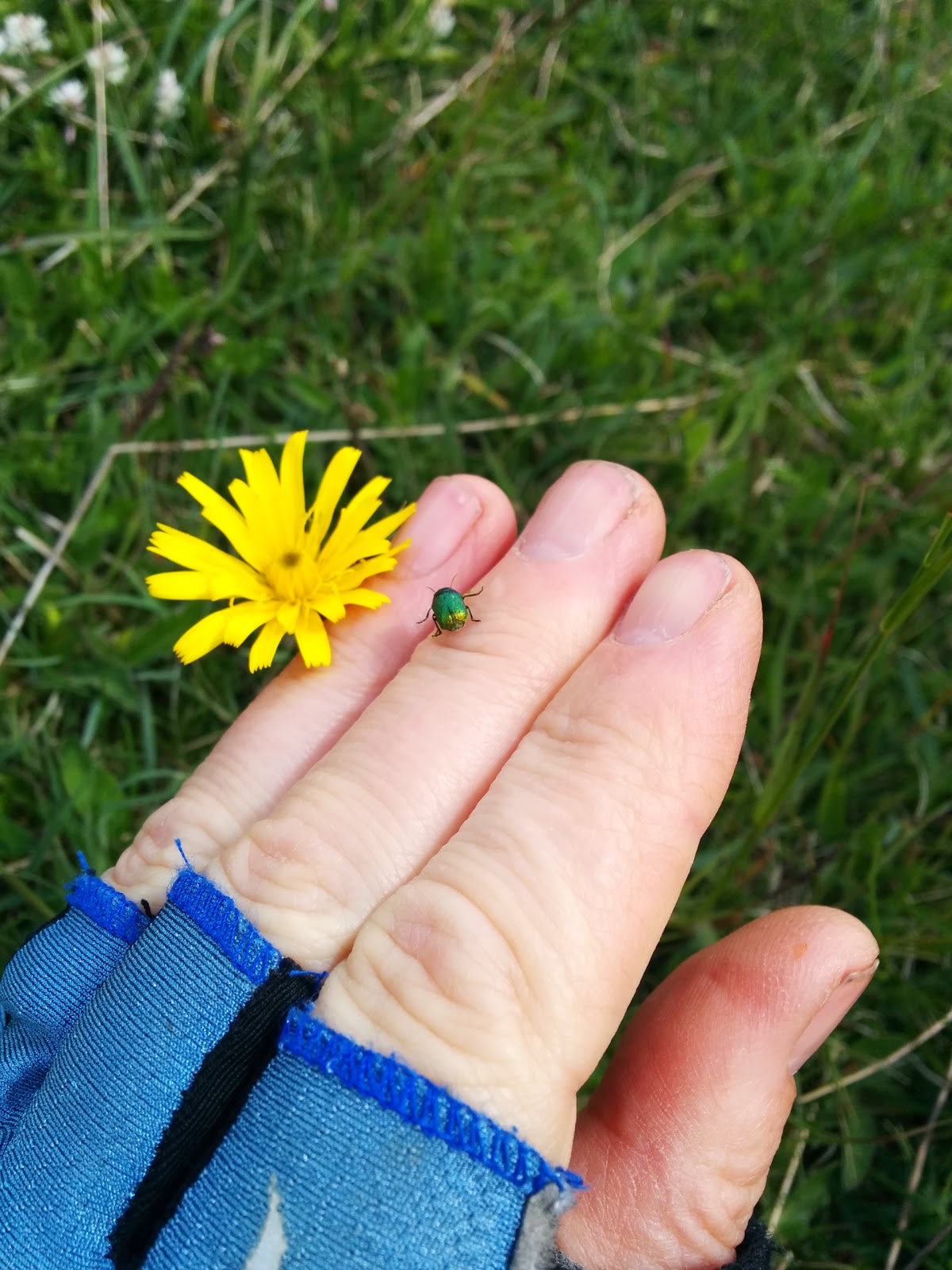
Well this is a bobby-dazzler, as my dad used to say (and possibly still does from time to time (not about this particular creature, but when something was particularly visually impressive)). I came across it when looking again for the early spider orchids Andy and I had seen on our bike ride a few weeks ago. It was sitting in the yellow flower like an emerald ornament. 
Entomology is mostly a mystery to me at the moment, something I look forward to remedying, so of course I had no idea what it was. The interweb is a marvellous place and within minutes help was to hand. It was suggested to be from the genus Cryptocephalus (cryptic-headed due to the head being almost invisible beneath the pronotum) and after a few suggestions followed by sleuthing various websites, I have decided it is Cryptocephalus aureolus rather than Cryptocephalus hypochaeridis which has bluer/darker elytra (wing cases (getting with the entomological jargon!)).

Tuesday, April 28, 2015

Bombus hortorum


This is a female Bombus hortorum. You can tell by the two thoracic yellow stripes, the yellow abdominal one and the white behind. It is female as it has an (empty) pollen basket and 13 segments to its antennae (males have 12). It also has a very long face to accommodate its very long tongue. As a consequence of the latter it favours flowers with long corolla tubes such as foxgloves, Lamium species and clovers. 
This one was a little worse for wear. Hopefully not overcome by neonicotinoid poisoning.

Wednesday, April 08, 2015

Small Tortoiseshell

Not the greatest picture but I was very excited to see the first butterfly in the garden this year. It's a small tortoiseshell, Aglais urticae. It is one of our commonest butterflies in the British Isles and, in the south at least, has two broods per year. The second brood emerges in September - October and hibernates over winter to emerge in the first warm days of spring. Unlike many species these are not colonial breeders; rather they range about and lay eggs whenever favourable habitat is encountered. They sometimes travel considerable distances, regularly crossing the English Channel. 
They are creatures of habit: the males get up around 10am (when it's nice weather), fly around for a couple of hours feeding and enjoying the sun, then after lunch they find a suitable territory in a sheltered sunny south-facing spot near nettles and fly up to check out any other small tortoiseshells flying past. If male, they have a 'fly-off' which involves spiralling up just behind and above the opponent before diving down and repeating. The winner stays put, but if after about an hour and a half he's had no luck with the ladies he finds another territory and hangs out until around tea time when he calls it a day. 
Should a lady pass she is pursued at great speed, sometimes for up to three hours, before getting down and dirty in the nettle-patch. The lady then spends the rest of her time selecting with great care the ideal nettle leaf to lay eggs on. They lay 60 - 100 eggs at a time, usually underneath the topmost leaf on an edge of a nettle patch in full sun. 
The Large Tortoiseshell used to be widespread in the wooded areas of southern Britain but mysteriously declined and became extinct around 40 years ago. 
I must just put in a pitch for the book from which the above information was gleaned: The Butterflies of Britain and Ireland by Jeremy Thomas and Richard Lewington. The former is Professor of Ecology at Oxford; the latter is surely one of the best wildlife illustrators around today. The illustrations in this book are exquisite and the text is distilled deep knowledge about these creatures. It's published by British Wildlife Publishing who do the British Wildlife magazine and several other field guides which are highly recommended.
So we're more than a quarter of the way through the year and approaching the hundredth post. To be honest it hasn't been that difficult finding species and I suspect it will be difficult deciding which to leave out as spring progresses, but I do find myself wondering which new species I'll be able to find next January, February and March.

Tuesday, March 17, 2015

Water Measurer

Can  you spot it? It's the insect standing on the surface next to the green grass blade protruding through the water in the centre of the picture.
The water measurer, or Hydrometra stagnorum is a 9- 12mm long beastie found throughout Great Britain on still water. It spears mosquito larvae, fleas and other small prey through the surface with its beak.


Tuesday, February 17, 2015

Western Honey Bee

Some of you might be thinking 'he's done crocus before' and you'd be right. But it's not the crocus, it's the bees. Apis mellifera was out and about in numbers for the first time this year in our garden. It was a beautiful day with temperatures reaching twelve degrees centigrade. The same evening I saw our resident bat out and about hawking for insects, which struck me as very early to be out of hibernation. (Perhaps they go back to bed after a snack?)
The big concern recently has been about colony collapse disorder (CCD) which has been variously attributed to many things, including neonicotinoids used in agriculture. However a virus is currently high on the suspect list: Israeli acute paralysis virus.
They are amazing creatures for all sorts of reasons but I'm too bunged up with a nasty cold and it's too late to enumerate them all. So here's a link to follow if you're interested.

Friday, January 09, 2015

Buff-tailed bumblebee

In order to make up from some rather lazy posting of organisms from far flung times, this one's right up to date. Amazingly this beauty bashed into my kitchen window this morning as I was re-fuelling the wine rack. 
There was a slight delay as the penny dropped: what on earth was a bumblebee doing out at this time of the year and in weather like this. (The sunny spell was a freak event in a long period of either cold or wild and milder weather. It is now wild and mild outside with gale force winds.)
I am no expert on bumblebees but I think this is Bombus terrestris. The only concern is that the stripe on the thorax is a little orangey. I posted it on iSpot hoping for confirmation, but none as yet.

There's something endearing about bumblebees that spiders and flies just don't have. I think it's their ridiculous proportions and their hairy/furry appearance. Denuded of hair and seen in their chitinous wherewithal they'd create a quite different reaction. 

They used to be called humble-bees, quite commonly, up until around the first world war, as well as bumblebees. Both are very old names, with the former recorded in the fifteenth century and the latter in the sixteenth. Then, for no discernible reason, the use of humble-bee just gradually tailed off. Since the second world war only bumblebee has been used as the common moniker. Weird.

Humble-bees are in the phylum Arthropoda, the class Insecta and the order Hymenoptera. It is one of the largest orders, with over 150,000 species of ant, bee, wasp and sawfly described. The name refers to their membrane wings (from the Greek). The family is the Apidae, which basically contains all the bee-like, waspy type creatures. Important pollinators all (when not being discombobulated by neonicotinoids and the like!). 

The other notable thing about humble-bees is that Uncle Charles (Darwin) cited them in a discussion about the interconnectedness of species. To paraphrase: humble-bees seem to be the only pollinators for some plants; the number of humble-bees is inversely proportional to the number of field mice (which predate the nests); the number of mice is inversely proportional to the number of cats; there are more cats near human habitations; therefore the keeping of cats by humans influences the success of some flower species. A correspondent of his, Mr Newman, had observed more humble-bee nests near to villages and towns and this provoked the ideas. The term 'ecology' wasn't being used at the time.

Another curious thing about humbe-bees is that their eponymous buzzing comes not from the wings beating the air, but from the noise of their flight muscles. The wings beat at around 200 times per second, which is faster than a nerve could repeatedly fire. The muscles actually vibrate after each nerve stimulus, which is not only physiologically necessary, but also much more energy efficient. They can de-couple their muscles from their wings and will use this to bring their body temperatures 'up to steam' before take-off if the ambient temperature is low. 

Friday, January 02, 2015

Common Pygmy Woodlouse

My species today is a Crustacean:  Trichoniscus pusillus or the common pygmy woodlouse. 

I suspect you just thought "woodlouse" when you saw the picture, but there are apparently 45 species in the UK. This is one of the 'famous five' which make up the vast majority of those we're likely to come across. 

You can perhaps guess from the photo where I found it? Those are annual growth rings on a log from the wood pile. 

So crustaceans are in the same Kingdom as humans: Animalia. Living things are classified into more and more specific groups, until one arrives at species and sub-species. (This business of classification is called 'taxonomy' and it is a classic scientific strategy for getting our heads around stuff.)

Our Kingdom is divided into 35 Phyla and that's where we separate: our friend here in Arthropoda whereas we're in with the Chordata. Crustacea is in fact a sub-phylum of Arthropoda and there's an awful lot of stuff in there besides woodlice. Moving down through the classification system, woodlice are in the Class called Malacostraca (I'd never heard of it until just now either!) which contains all sorts, from huge spider crabs to tiny shrimps. (There are six classes of crustaceans.)

Next down is Order. Woodlice are in the Isopoda order. From what I can gather, they all look like your common-or-garden woodlouse. If you go down to the bottom of the ocean you can find one about half a metre long.

Imagine finding that in your wood pile.